
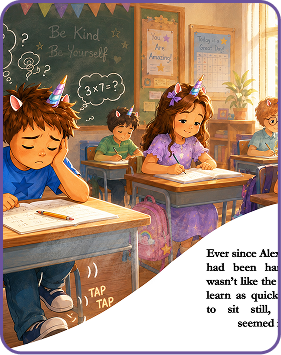
Every classroom has an Alex. Maybe it’s the kid who can’t sit still without wiggling in his chair. Maybe it’s the one who wears headphones during recess or gets a little too excited talking about rocks. Every teacher knows this child, and every child deserves to see themselves on the pages of a book. That’s exactly why Alex and the BIG Eruption is more than a fun story about a science fair gone wonderfully wrong. It’s a book that belongs on every classroom shelf.
A Story I Wrote for Kids like Alex
I wrote this story because I wanted kids like Alex to open a book and think, “Hey, that’s me.” So many children who learn differently grow up feeling like the odd one out. They notice the way other kids finish their worksheets faster, or how their fidgeting gets side-eyes instead of understanding. I wanted to write a story where that same child gets to be the hero, wobble chair and all.
Getting to Know Alex
Alex has ADHD and Autism, and while that shapes how he moves through his day, it never defines who he is. He’s curious. He’s funny. He has the best rock collection in the fourth grade, and he loves science with his whole heart. When I sat down to write him, I didn’t want him to be a “lesson” wrapped up in a character. I wanted him to feel like a real kid, because so many real kids feel exactly like him every single day.
Why This Matters in the Classroom
For teachers, that’s what makes this book such a powerful classroom tool. Alex isn’t defined by a diagnosis. He’s defined by his curiosity, his humor, his love of pizza on Fridays, and his big, brave heart. That’s the kind of representation I hope every child, whether they learn differently or not, gets to see in their reading corner. Kids need books that mirror their own experiences, and they need books that build empathy for their friends who experience the world a little differently too.
The Moment That Says It All
There’s a moment in the story where Alex accidentally adds too much baking soda to his volcano, and it erupts far higher than anyone expected. In a real classroom, a moment like that could easily become embarrassing. Instead, his classmates cheer. They celebrate the surprise instead of laughing at it. I wrote that scene very intentionally. I wanted young readers to see what real inclusion looks like in action, not as a lecture, but as a moment of pure joy shared by an entire classroom.
Opening the Door to Conversation
Teachers already do so much heavy lifting when it comes to building inclusive spaces. Story time can help carry some of that weight. When a class reads about Alex’s wobble chair, his headphones, or the way loud construction noise overwhelms him on the car ride to school, it opens the door for conversations that might not happen otherwise. Kids start asking questions. They start noticing their own classmates a little differently. A wobble chair stops looking strange and starts looking like something helpful, something normal, something no big deal at all.
A Book That Does Double Duty
I’ve heard from parents and teachers that the best classroom books are the ones that do double duty. They entertain, and they teach empathy without kids even realizing it’s happening. That’s exactly the space I hope Alex and the BIG Eruption fills. It’s got a big, funny volcano explosion that will have kids giggling and gasping. It’s got a sweet mom who shows up with hugs and encouragement. And underneath all of that, it’s got a message that every child, no matter how their brain works, has something extraordinary to offer.
Give Alex a Spot on Your Shelf
If you’re a teacher building your classroom library this year, I hope you’ll consider giving Alex a spot on your shelf. Let him sit next to the other picture books your students already love. Let his story spark a conversation about wobble chairs and headphones and big feelings. And most of all, let every child in your classroom, the ones who learn differently and the ones who don’t, see a little bit of themselves in his story. I’d love for you to pick up a copy and read it with your class. I think you’ll find that Alex doesn’t just belong in your classroom library. He belongs right at the front of it.