
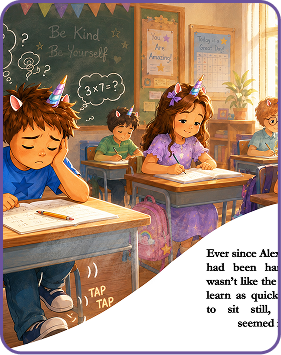
Kids are constantly comparing themselves to each other. Who finishes their homework first, who’s the fastest runner at recess, who gets picked for the game first. It starts so young, and it can quietly chip away at a child’s confidence, especially for kids who learn, feel, or move through the world a little differently. That’s why teaching self-acceptance early matters so much, and it’s the heart of everything I wrote into Alex and the BIG Eruption.
The Question That Started It All
When I first started writing Alex’s story, I kept coming back to one question. What if a child who struggles with the things that come “easy” to everyone else got to be the one who shines the brightest? Not despite being different, but because of it. That question became the whole reason I wrote this book.
Writing the Hard Mornings
Alex has ADHD and Autism. Some mornings, getting out of bed and facing school feels like the hardest thing in the world for him. He fidgets. He daydreams. He gets picked on by classmates who don’t understand him. If I’m being honest, writing those parts of his story was hard, because I know so many real kids live that exact experience every single day. But I didn’t want to stop there. I wanted Alex’s story to go somewhere bigger.
The Eruption That Says It Best
That’s why the science fair scene means so much to me. Alex pours his whole heart into his volcano project, the one thing at school that makes him feel excited instead of anxious. And when it erupts far bigger than planned, instead of shrinking with embarrassment, he gets cheered on by his entire classroom. That moment is the whole message of the book wrapped into one big, foamy eruption. Being different isn’t something to hide or apologize for. Sometimes it’s exactly what makes you shine.
Self-Acceptance Lives in the Small Things
I think we forget how much power there is in a child simply feeling accepted for who they are. Self-acceptance doesn’t usually show up as one big dramatic moment. It shows up in the small things, like a wobble chair that lets a kid focus instead of being told to “sit still.” It shows up in headphones that turn an overwhelming, noisy world into something manageable. It shows up in a mom who asks gentle questions instead of getting frustrated. Every one of those details in Alex’s story was written to show kids, in small everyday ways, that needing something different isn’t a weakness. It’s just what helps them thrive.
Planting a Seed, One Story at a Time
I also wanted parents and teachers to walk away from this book with something useful. Self-acceptance isn’t a lesson kids learn once and then just have forever. It’s something we build slowly, story by story, moment by moment. When you read this book with a child, whether they relate to Alex directly or they’re learning to understand a classmate who does, you’re planting a seed. You’re teaching them that different brains, different bodies, and different ways of learning are all worth celebrating, not fixing.
More Than a Trophy
By the end of the story, Alex isn’t just accepted by his classmates. He’s celebrated. He walks away with a trophy, sure, but more importantly, he walks away believing in himself a little more than he did that morning. That’s the real ending I hope stays with kids long after they close the book. Not the trophy. The confidence.
If you have a child in your life who sometimes feels like they don’t quite fit the mold, I hope you’ll share Alex’s story with them. If you have a child who’s still learning what empathy looks like, I hope this story helps too. Either way, grab a copy, curl up together, and let Alex remind you both that being different isn’t something to overcome. It’s something to be proud of.